
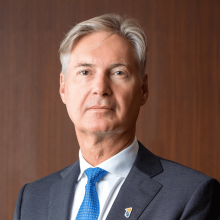
Giel-Jan Van Der Tol, Chief Executive Officer, Al Ahli Bank of Kuwait (ABK)
Giel-Jan Van Der Tol, Chief Executive Officer, Al Ahli Bank of Kuwait (ABK)
From your experience advising boards and now leading a listed banking group, what governance lessons have become most relevant as boards prepare for 2026?
One lesson stands out clearly: governance is no longer about structure, it is about behaviour. Most boards now have strong frameworks, committees and policies. What differentiates them is whether they use them with courage and discipline.
As we proceed in 2026, three lessons feel particularly relevant. First, risk appetite must be real, not decorative. In regulated sectors like banking, it must guide decisions daily – not sit quietly in an annual report. Secondly, capital allocation discipline is becoming a core governance responsibility. Growth without resilience is not strategy; it is optimism. Thirdly, transparency with regulators and stakeholders has become a strategic asset. I believe boards that succeed will be those that move from reviewing the past to stress-testing the future. Reflection is useful, but only if it leads to better forward decisions.
In short, governance is shifting from compliance to competitive advantage.
How does the relationship between the board and the CEO need to evolve to ensure effective strategy execution in today’s environment?
The traditional model of 'board supervises, CEO executes' is no longer sufficient. Today, execution risk is as critical as strategy risk.
The relationship must evolve from episodic interaction to structured, continuous dialogue. The board must remain independent, but not distant. Effective boards challenge assumptions early, not after outcomes are visible. Equally, CEOs must be transparent about uncertainty. In fast-moving environments, perfection is unrealistic. What boards need is clarity of reasoning, disciplined risk assessment, and early warning signals.
Trust is built not by agreement, but by candour.
The best board/CEO relationships I have seen are intellectually rigorous and personally respectful. There is space for debate, but less room for ego. When both sides understand that they share the same objective, i.e. long-term institutional strength, alignment becomes natural.
A good test: if strategy discussions feel uncomfortable but constructive, the relationship is probably healthy.
What capabilities do you believe boards must strengthen to remain effective in highly regulated and fast-changing sectors such as banking?
In highly regulated and fast-changing sectors, three capabilities stand out. First, regulatory fluency. Directors do not need to be regulators, but they must understand supervisory thinking, capital dynamics and systemic risk. Regulation shapes strategy more than many admit. Second, technological literacy. Digital transformation, AI, cyber risk, these are no longer 'IT topics'. They are enterprise risk topics. Boards must be comfortable asking informed questions, not generic ones. Third, geopolitical awareness. Cross-border capital flows, sanctions, liquidity markets are increasingly influencing business models.
The board composition conversation must therefore move beyond diversity of background toward diversity of cognitive skill sets. Financial expertise remains essential, but behavioural insight, crisis navigation and transformation experience are equally important.
The boardroom of 2026 must combine prudence with curiosity. Without curiosity, prudence becomes rigidity.
How can boards strike the right balance between oversight, challenge, and support while maintaining trust and accountability?
This balance is less about process and more about tone. Oversight requires independence. Challenge requires preparation. Support requires empathy. If one dominates, the balance collapses.
Boards must ask difficult questions, especially when results are strong. Ironically, complacency risk is highest during success. At the same time, in periods of stress, the board must avoid becoming operational.
A useful principle is: challenge the assumptions, not the individuals. Accountability should be clear and measurable. But accountability without psychological safety leads to information filtering, which is potentially dangerous.
Trust is built when management knows that the board will hold them responsible, but will also stand behind them when decisions were reasonable, even if outcomes disappoint. High-performing boards are demanding, but fair.
Looking ahead, what is one board practice you believe will distinguish high-performing boards in the GCC over the next few years?About Giel-Jan
The practice that will distinguish high-performing boards in the GCC over the coming years is discipline and forward-looking time allocation. Too many boards still spend the majority of their agenda reviewing historical performance. Necessary, yes, but insufficient.
The strongest boards I know allocate structured time to scenario planning, capital resilience and strategic stress testing. Not once a year, but routinely. They also evaluate their own effectiveness with honesty, including peer feedback and periodic external reviews. Governance maturity begins with self-awareness.
Finally, high-performing boards institutionalise learning. Post mortems are conducted not to assign blame, but to improve judgment. In essence, the board that treats governance as a living system, rather than a compliance checklist, will outperform. Or, put simply: the future rewards boards that prepare for it deliberately.
About Giel-Jan
Giel-Jan (“GJ”) began his career as International Career Banker at ABN AMRO Bank of the Netherlands, where he worked 21 years holding several executive positions of increasing responsibility. In 2000 he was appointed Global Head HR of the Global Markets Division in Amsterdam/London, after which he served as Chief Operating Officer of Saudi Hollandi Bank (SHB) in Riyadh. In 2005 he was appointed CEO and Managing Director of SHB. He also held the positions of Managing Director of Tier One Capital in the Netherlands and Chief Executive Officer of Dubai Bank in the UAE. After the merger of Dubai Bank with Emirates NBD Bank in 2012, he became a member of the latter’s Group Executive Committee, serving as Global Head Wholesale Banking, followed by the position of CEO and Managing Director of Emirates NBD Bank Egypt.
Giel-Jan has worked in multiple jurisdictions, including the Netherlands, Ecuador, United States of America, Pakistan, Lebanon, Aruba, United Kingdom, Saudi Arabia, Egypt and the United Arab Emirates, holding executive positions in a wide variety of functions including Corporate & Investment Banking, Retail, Commercial, Small Business, Asset Management, IT & Operations and Offshore Banking.
He has served on a variety of boards in the Middle East since 2005. Currently he is Board Member of Tamweel Aloula Finance Co. in Saudi Arabia, also serving on its Board Credit Committee, and as Chairman of the Board Nomination & Remuneration Committee. He is a member of the EMEA Advisory Council of his alma mater, the Thunderbird School of Global Management of Phoenix (AZ), United States of America.
Giel-Jan holds a Bachelor degree in Business Administration from Nyenrode University in the Netherlands and a Master in International Management from the Thunderbird School of Global Management (USA). He has a Certificate in Board Directorship from the GCC Board Directors Institute.