
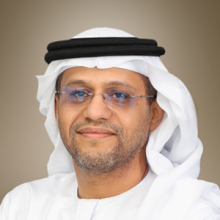
Abdulla Salem Alnuaimi, Group CEO, Abu Dhabi Securities Exchange (ADX)
Abdulla Salem Alnuaimi, Group CEO, Abu Dhabi Securities Exchange (ADX)
Strengthening Governance, Empowering National Leadership.
1. From your perspective as Group CEO of Abu Dhabi Securities Exchange, how are changing capital-market dynamics influencing the way organisations approach governance and leadership?
Capital markets are moving faster, becoming more interconnected and increasingly shaped by information, technology and investor expectations. This is fundamentally changing what good governance and effective leadership look like.
Strong boards have long regarded governance as more than just a periodic compliance exercise. Strong boards embed governance in how they make decisions, manage risk, communicate performance and create long-term value.
Shareholders and investors today have swift access to more information, more sophisticated analytical tools and a wider choice of markets and assets. They are looking beyond financial performance to understand the quality of leadership, capital allocation, sustainability of the business model, succession planning, risk management and the credibility of management’s strategy. This places a greater responsibility on boards to ensure that the company’s strategy is clearly articulated and consistently understood by the market.
This is where Investor Relations becomes strategically important. For listed companies, IR should not sit at the periphery of the organisation. It should provide the board with a continuous understanding of how investors perceive the company’s strategy, performance, risks and prospects, while ensuring that the market receives clear, timely and consistent information. A strong IR function can effectively serve as the bridge between the board, management and the investment community.
The urgency is clear: capital follows confidence, and confidence is built over time through transparency, accountability and credible leadership. GCC companies seeking greater access to domestic and international capital must therefore raise governance and investor engagement to the same level of importance as financial performance. Strong boards will increasingly be distinguished not simply by how they govern, but by how effectively they build trust in the future of the organisation.
2. What role does strong corporate governance play in strengthening investor confidence and supporting the development of deeper and more resilient capital markets?
Strong corporate governance is ultimately about trust. Investors must have confidence that companies are being directed responsibly, that their interests are protected, that risks are understood and that management is being held accountable for delivering sustainable value. Without this foundation of trust, even strong financial performance may not translate into a sustainable valuation or a broad and stable investor base.
For capital markets to deepen, investors—particularly international and institutional investors—need confidence not only in individual companies, but in the integrity of the market as a whole. Consistent governance standards, high-quality disclosures, independent oversight, effective risk management and transparent decision-making collectively create that confidence.
For board directors of listed companies, Investor Relations is an increasingly important component of this governance ecosystem. IR is not simply about communicating results after the quarter has ended. It is about maintaining an informed and credible dialogue with shareholders and potential investors, understanding how the market interprets corporate performance and ensuring that the company’s investment proposition is communicated with clarity and consistency. Boards should therefore receive meaningful investor feedback and market intelligence as part of their strategic oversight.
This becomes particularly important during periods of volatility or uncertainty. Markets will inevitably experience cycles, geopolitical events and changing investor sentiment. What distinguishes resilient companies is the quality and consistency of their communication before, during and after those periods.
Good governance does not eliminate uncertainty; it gives investors confidence that uncertainty is being managed responsibly.
As our economies diversify and our capital markets attract increasing international participation, governance excellence can become a competitive advantage, strengthening investor confidence, improving the quality of capital formation and supporting the development of deeper, more resilient markets.
3. How can boards ensure that governance frameworks support strategic ambition and long-term value creation rather than becoming purely compliance-driven?
The most effective boards understand that governance and ambition are not opposing forces. In fact, strong governance creates the confidence and discipline that allow organisations to pursue greater ambition.
The danger is when governance becomes a checklist—focused primarily on whether policies exist, meetings have been held and requirements have been satisfied. Compliance is necessary, but it is only the foundation. The real question for a board should be: does our governance framework help us make better decisions, identify risks earlier and create sustainable value?
This requires boards to spend more time on strategic questions: Where will our growth come from? How are technology and AI changing our business? Are we allocating capital effectively? What risks could undermine our strategy? Do we have the leadership and talent required for the next phase of growth? And importantly, do investors understand and believe in our long-term strategy?
This last question reinforces the importance of Investor Relations as a board-level strategic capability. Regular engagement with investors provides valuable insight into how the market views the company’s strategy, capital allocation, performance and risks. Boards should use that intelligence constructively—not to manage short-term market sentiment, but to test whether the company’s long-term investment proposition is sufficiently clear and credible.
Governance should therefore create a constructive tension between ambition and accountability. Boards should challenge management, but also enable management to act decisively within a clear framework of responsibility.
In today’s markets, the cost of slow decision-making, unclear accountability or poor communication can be significant. Boards must move from asking, “Are we compliant?” to asking, “Are we governing in a way that enables this organisation to compete, grow and create lasting value?”
That is the standard that modern governance increasingly demands.
4. What does empowering national leadership mean in practice for organisations operating within the UAE’s rapidly developing financial and economic ecosystem?
Empowering national leadership is about much more than representation. It means creating the capability, confidence and institutional platforms for national talent to lead organisations, make complex decisions and shape the next phase of economic development.
The UAE has built an exceptionally dynamic economic ecosystem, supported by ambitious national strategies, world-class infrastructure and an increasingly sophisticated financial sector. The next stage of development will require leadership that combines an international perspective with a deep understanding of the UAE’s national priorities and long-term ambitions.
For boards, this means taking a deliberate approach to developing national leadership pipelines. Emiratisation should not be viewed simply through the lens of numbers or recruitment. Organisations should invest in developing Emirati leaders with exposure to strategy, capital allocation, technology, risk, international markets and corporate governance. They should be given meaningful responsibilities and opportunities to participate in decisions that shape the future of their organisations.
This also extends to the leadership of listed companies. As the UAE’s capital markets become increasingly international, national leaders must be equally comfortable engaging global investors and explaining the company’s strategy, competitive advantages and long-term value proposition.
Here again, Investor Relations has an important role to play. Board directors and national executives need to understand how institutional investors assess companies, what information influences investment decisions and how credibility is built with international capital. Investor engagement should therefore become part of leadership development, not simply a responsibility delegated to the IR or communications team.
Empowering national leadership ultimately means building leaders who can represent their organisations with confidence on both the domestic and international stage.
The opportunity is significant. The UAE is not simply developing companies; it is developing institutions capable of competing globally. Strong national leadership will be one of the most important assets in that journey.
5. Looking ahead, what governance and leadership priorities will be critical to strengthening Abu Dhabi’s position as a leading regional and international capital markets hub?
For the UAE, investors recognise its consistent potential. The combination of trade-route optionality and listed infrastructure-related companies gives investors more direct public-market exposure to the investment cycle.
Over the years, Abu Dhabi has demonstrated its strengths as a leading international financial and capital markets hub through its industries, innovation and listed entities. To maintain this momentum, every stakeholder in this ecosystem needs to ensure continued leadership in governance, transparency, innovation and investor engagement.
First, boards must continue to raise the standard of governance. International investors will increasingly compare GCC companies not only with regional peers, but with leading companies globally. High-quality disclosure, effective board oversight, robust risk management, credible succession planning and disciplined capital allocation will therefore become increasingly important.
Second, companies must strengthen the quality of their relationship with investors. Investor Relations should be recognised as a strategic board-level function, particularly as Abu Dhabi seeks to attract greater international institutional participation. Investors want to understand not only what a company has achieved, but where it is going, how it intends to create value and what could prevent it from achieving its objectives. Boards should ensure that management has the capability to articulate this investment proposition consistently and credibly.
Third, leadership must embrace technology and AI while ensuring that innovation is matched by appropriate governance. The pace of technological change means boards must understand not only the opportunities, but also the implications for data, cybersecurity, operational resilience, decision-making and risk.
Finally, we need to think beyond individual companies. A world-class capital market is built through the collective confidence of issuers, investors, intermediaries, regulators and market infrastructure.
For Abu Dhabi, the ambition should be clear: to build a capital market where global investors have confidence in the quality of its companies, the strength of its institutions and the credibility of its leadership.
The GCC is entering an increasingly competitive phase of capital-market development. The boards that act decisively today—strengthening governance, developing national leadership and building genuine investor relationships—will help determine which markets lead tomorrow.