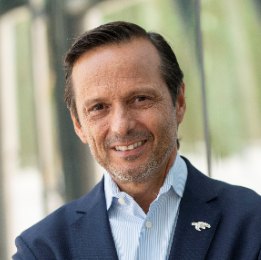
 John Pagano is the Chief Executive Officer of The Red Sea Global and AMAALA, sister projects set along the north- western coast of Saudi Arabia that will play key roles in the realisation of the Vision 2030 – KSA’s economic roadmap for the future.
Prior to joining The Red Sea Global and AMAALA, John established his own international strategic advisory company, Old Fort Capital Investments Ltd, drawing on his extensive experience, providing strategic advice internationally on large scale real estate developments. John holds a BASc degree in Mechanical Engineering from the University of Toronto. He also studied Corporate Finance at the London Business School.
Q1- GCC BDI is delighted that The Red Sea Global is the sponsor of GCC BDI’s 8th Chairman Summit in October 2022. What inspired you to partner up with GCC BDI for this event?
JP: We appreciate that the Chairman Summit is GCC BDI’s premier event of the year, attracting influential chairmen and business leaders and regulators from across the Gulf region. The main goal of the gathering is to spark a dialogue about governance and board issues and to raise awareness and enhance best governance practices in GCC countries.
These issues are of vital importance to my company. The Red Sea Global is young, only five years old, but we’re growing fast and hiring new employees every week. We understand that good governance, transparency, and diversity are crucial -- both to our culture and our bottom line. So, we’ve gone to a lot of effort to instil international best practices.
Given that we share this core value with GCC Board Directors Institute, it made excellent sense for us to partner on this important event.
We also see this summit as a compelling opportunity to share our experiences and learn from our peers in the region. Partnering with GCC BDI gives us the opportunity to speak with like-minded individuals and support good governance practices, which in turn will help to strengthen governance standards across the region.
Q2- GCC BDI is strongly motivated to enhance corporate governance and board effectiveness across the GCC. How does The Red Sea Global support this vision in your own business activities?
JP: We aim to create one-of-a-kind tourism destinations. To succeed, we need to take a holistic approach that includes setting new benchmarks for good governance, compliance and risk management. We’re determined to go above and beyond with our project’s governance - just as we’re doing in setting new standards for regenerative tourism, generating opportunities for advancement in local communities, and creating unparalleled experiences for our guests.
Simply complying with mandated legal and regulatory requirements isn’t enough. We plan to exceed them by following international best practices for governance. We’re doing the same with our compliance and reporting structures, adopting the Open Compliance & Ethics Group principled performance approach for an integrated Governance, Risk, and Compliance Framework. We’re also taking a technology-driven approach, with an integrated Enterprise Governance, Risk Management and Compliance platform.
We’re committed to maintaining the highest professional standards of corporate governance and professional directorship. And we apply these same principles to the businesses and organizations we work with, to ensure that our external stakeholders are as committed as we are to the highest standards of ethical conduct.
Q3- GCC BDI is celebrating its 15th anniversary in 2022. How do you think corporate governance and board effectiveness in the GCC has evolved since 2007?
JP: The trend is extremely encouraging, thanks in no small part to advocacy and support from GCC BDI. A growing number of businesses in our region are embracing the need for good governance and greater transparency and diversity.
One catalyst has been shareholder activism, as more and more companies in the GCC issue shares to the public and get listed on stock exchanges for the first time.
I think the positive trend is also a function of globalization and the widening web of international linkages forged by companies in our region. As local businesses look further afield for trading and investment opportunities, they learn and understand that they need to adopt international best practices to compete more effectively.
Some companies in the GCC, like mine, have had the good fortune to build from scratch, drawing on expertise and talent from around the world as well as our Saudi Arabian home. Because we started with a clean slate, we’ve been able to instil and institutionalize best practices from the outset. In my experience, both within this region and outside it, a meritocratic approach to building a business leads naturally to healthier corporate governance and more effective boards.
Q4- Can you kindly share a few words to congratulate GCC BDI on reaching this milestone?
JP: We at The Red Sea Global are delighted to be able to join GCC BDI in helping you celebrate your impressive achievement. Over the past 15 years, you’ve evolved into the Gulf’s brightest beacon for effective governance.
When you began your journey in 2007, you were a start-up non-profit organization with a worthy cause. Good corporate governance was not an idea with deep roots in GCC countries.
Today, good governance is a major priority for the region’s board chairs and executives. They understand that it makes their companies more attractive to potential investors and partners, and they’ve come to value it as a pillar for long-term sustainability. You deserve much of the credit for this change in mindset.
Gone are the days when boards in the GCC played the role of passive observers. Now they’re empowered with a mission to question, challenge and inspire strategy, improve risk management and encourage plans for management succession.
From family-owned firms to publicly traded companies, GCC BDI has helped businesses acquire the knowledge and tools they need to achieve and sustain robust governance.
Congratulations! Mabrouk! We look forward to joining you for the next 15 years and beyond.