
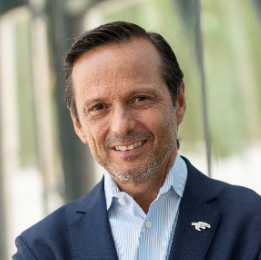
 John Pagano is the Chief Executive Officer of The Red Sea Development Company (TRSDC) and AMAALA, sister projects set along the north western coast of Saudi Arabia that will play key roles in the realisation of the Vision 2030 – KSA’s economic roadmap for the future.
At TRSDC and AMAALA, John is leveraging his 38 years of international experience in delivering large scale multi-billion-dollar developments. Since 2018, he has led The Red Sea Development Company’s growth from the ground up and is creating a unique eco-luxury, sustainable, regenerative tourist destination that will contribute to transforming the global tourism industry and to the diversification of the Saudi Arabian economy. In January 2021, he was appointed as CEO of AMAALA, and tasked with driving the next stage of development for the ultra-luxury destination.
1. As the developer behind one of the world’s most ambitious tourism initiatives, can you tell us more about the vision of The Red Sea Development Company and what you hope to achieve?
The Red Sea Development Company will support the delivery of Saudi Arabia’s ambition for a diversified economy by expanding its international tourism sector, a core pillar of Vision 2030.
We are leading the global transition towards regenerative tourism – going beyond sustainability to have a regenerative impact on not only the environment, but also on society and the economy too.
For example, The Red Sea Project has set itself the ambitious goal of achieving a 30% net conservation benefit by 2040, a target unheard of in tourism. We’re going beyond conservation to give back to the environment and to enhance habitats, wildlife, and surrounding communities.
Our approach to setting new standards in sustainability appeals greatly to travelers today who are looking for more meaningful experiences and we want to become a gateway for visitors from across the world to discover Saudi Arabian history, engaging with its rich heritage and traditions, as well as its natural beauty.
Through this, we can truly support the Kingdom’s transformation and fulfil Vision 2030.
2. What are the key milestones which have been achieved to date?
Work on both The Red Sea Project and AMAALA is progressing well. The Red Sea Project has surpassed significant milestones in the past year, with over 500 contracts signed to date, worth over SAR 16 bn ($4.2bn). Activity for the first phase of development, which focuses on enabling the infrastructure to support future work, is well underway. The Construction Village, which houses 10,000 workers, is now open and fully operational and work is also progressing at the Coastal Village, which will be home to around 14,000 people who will eventually work at the destination. We’ve started laying asphalt on our 3.7km code F runway and completed some 80km of new roads to better connect the destination.
Work on AMAALA also continues at pace, awarding more than 180 contracts worth 3 billion SAR and set to award a multi-billion-riyal Public-Private Partnership (PPP) contract for the destination’s utilities before the end of the year. We have completed the master plans for the destination, and construction on the first phase of the worker village is close to completion. Key contractors have been mobilized with more than 1200 employees on-site and construction is well underway on key sites including the airport and marina.
By bringing both destinations under the leadership of The Red Sea Development Company, we are utilizing the learnings and practices of each project and applying them across both sites. This will ensure we adhere to the same high standards across both destinations for these and any further projects we undertake.
3. How important is governance and board effectiveness to The Red Sea Development Company?
We are striving to build world-class tourism destinations, and that means taking a comprehensive approach that sets new standards in good governance, compliance and risk management. In just the same way that we have committed to setting new standards in regenerative tourism, generating socio-economic opportunities in our local communities and creating unrivalled experiences for guests, we are going above and beyond on our project’s governance.
We are not just complying with local legal and regulatory framework requirements – we are setting our sights higher, and plan to exceed these by adopting globally leading governance practices. Additionally, we are looking to implement international best practices in our compliance and reporting structures, adopting the Open Compliance & Ethics Group (OCEG) principled performance approach for an integrated Governance, Risk, and Compliance Framework, in addition to implementing a tech-driven approach, using an integrated Enterprise Governance, Risk Management and Compliance (EGRC) platform.
4. Why has The Red Sea Development Company chosen to sponsor GCC BDI’s Chairman Summit 2021?
We are delighted to sponsor the Chairman Summit, because like the GCC Board Directors Institute, we are committed to promoting and adhering to the highest professional standards of corporate governance and professional directorship.
We aspire to exceed the mandated legal and regulatory requirements by adopting international leading governance practices. We also strive to not only hold ourselves to this high standard, but our principles extend to the parties and entities we work with to ensure that our external stakeholders are committed to the highest standards of ethical conduct.
By partnering with the GCC Board Directors Institute we have the opportunity to speak with likeminded individuals and support good governance practices, which in turn will help to improve governance standards across the Kingdom and the region.