
A Brief Guide to the Legal and Disciplinary Consequences of Medical Malpractice
Patients expect safe and error-free medical care, while physicians wish to practise their profession and make necessary treatment decisions without fear of excessive penalties, undue liability, or uncertainty regarding the legal proceedings that may be initiated against them in the event of medical malpractice.
This raises the fundamental question:
What legal repercussions does a doctor face upon committing medical malpractice in the United Arab Emirates?
This article seeks to answer this question concisely and in an accessible manner. It is directed at doctors and other healthcare professionals, with the aim of providing a practical understanding of the relevant legal procedures, while emphasising the importance of engaging lawyers who specialise in medical liability matters.
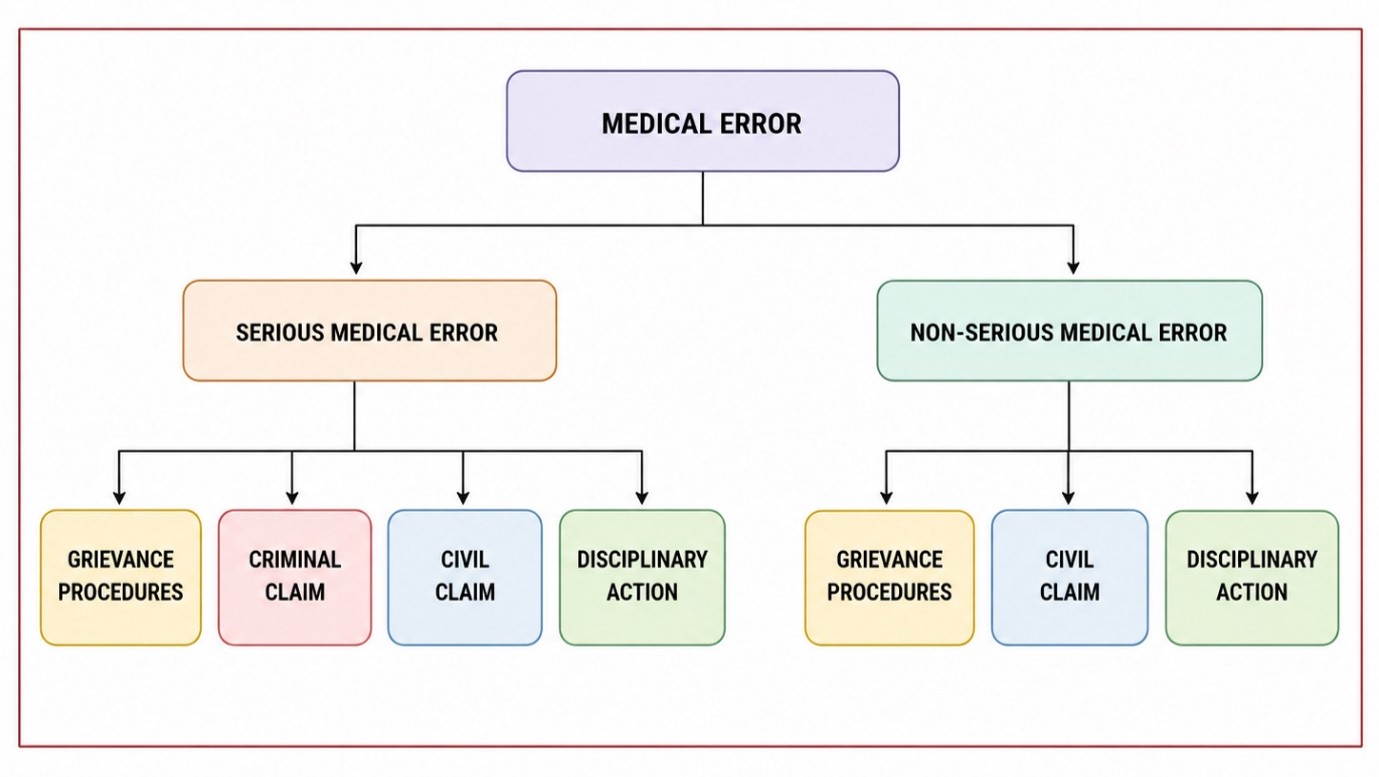
The diagram below illustrates the principal axes of legal and disciplinary procedures, each of which is explained in detail in the sections that follow.
First: Classification of Medical Errors by Degree of Seriousness
Medical errors are not all of the same degree of severity; they may be classified as either serious or non-serious. The legal proceedings that may be taken against a doctor or health practitioner vary according to the severity of the error, as determined by the competent medical committees in the country, following verification of the applicable technical and legal standards and a review of the facts and medical records relating to the error under evaluation.
Article (6) of Federal Decree-Law No. (4) of 2016 on Medical Liability (the “Medical Liability Law”) provides that a medical error is committed by a practitioner of the profession (such as a doctor or health practitioner) as a result of any of the following:
- Ignorance of technical matters that a Profession Practitioner of the same degree and specialisation would reasonably be expected to know;
- Non-compliance with recognized professional and medical principles;
- Failure to exercise due diligence;
- Negligence and inattention.
A non-serious medical error is determined according to the criteria outlined above.
As for serious medical malpractice, Article (5) of Cabinet Resolution No. (40) of 2019 concerning the Executive Regulations of the Medical Liability Law defines its criteria as follows:
- A medical error shall be deemed “gross” (i.e., a serious medical error) if it leads to the death of the patient or foetus, the eradication of a human organ by mistake, the loss of organ function, or any other serious harm, provided that any of the following criteria is also present:
- Unpardonable unfamiliarity with well-established medical standards, having regard to the level and specialisation of the professional practitioner.
- Adoption of a medically unrecognised method.
- Unjustified deviation from medical standards and rules for practicing the profession.
- The doctor is under the influence of alcohol, drugs, or psychotropic substances.
- Gross negligence or a clear lack of perception when undertaking well-established medical procedures — for example, leaving medical equipment in the patient’s body, administering an overdose of medicine, failing to operate a medical device during or after surgery, resuscitation or childbirth, failing to administer appropriate medication to the patient, or any other act classified as gross negligence.
- Deliberately practising the profession beyond the scope of specialisation or clinical privileges conferred upon the doctor under the professional licence.
- The doctor’s use of diagnostic or therapeutic means without prior practice or training and without medical supervision.
The competent medical committees are responsible for determining which standard applies to the medical error in question. In order for an error to be classified as serious, the medical committees must review the elements available in the patient’s medical file to confirm its existence. This process ensures that the error is properly classified as either serious or non-serious, together with a statement of the damages suffered by the patient.
Second: Legal and Disciplinary Proceedings Arising from Medical Error
In the event of a medical error, a doctor may face several legal and disciplinary proceedings, some of which vary depending on whether the error is classified as serious or non-serious. These proceedings are preceded by a verification stage conducted by the competent medical committees affiliated with the relevant health authority in the Emirate concerned. Each stage is explained in the following points:
1. Procedures for medical complaints and appeals before the relevant medical committees:
The Medical Liability Committee begins by examining medical complaints referred to it by the competent health authority, or complaints filed directly by the patient or their relatives. The Public Prosecution or the court (as applicable) must verify whether a medical error has occurred. At this stage, the doctor may be summoned by the Medical Liability Committee to present their defence from a technical standpoint. The committee subsequently issues its decision, clarifying who is at fault and the severity of the error (whether serious or non-serious). Furthermore, the committee provides a detailed description of the clinical error, the resulting damages, the causal relationship between the error and the medical professional, and the impact of the error on the patient (if any).
If a medical error is established on the part of the doctor — or, conversely, if the error is denied — the doctor or the complainant (the patient or their relatives) may appeal the report of the Medical Liability Committee within thirty (30) days from the date of its issuance. Such appeal is submitted to the Supreme Committee for Medical Liability of the Ministry of Health and Prevention.
The Supreme Committee for Medical Liability, a federal body, then examines the documents and renders its decision — either rejecting the appeal, amending the Medical Liability Committee’s report, or cancelling it entirely. The Supreme Committee’s report is considered final and is not subject to further appeal before any authority.
2. Criminal liability (criminal prosecution)
If the medical error is deemed non-serious, the doctor will not face criminal proceedings. Conversely, if the competent medical committees determine that the error constitutes a serious error according to the legally established standards — for example, where the error resulted in the patient’s death — the doctor may face a criminal complaint before the Public Prosecution, filed by the patient or their relatives. The matter may conclude with the file being closed or the case being referred to the competent criminal court. The court will then impose the penalty it deems appropriate for the serious medical error, in accordance with Article (34) of the Medical Liability Law, which may include imprisonment and a fine, or one of these two penalties. The duration of imprisonment or the amount of the fine varies according to the circumstances of the medical error.
3. Civil liability (compensation claim)
A claim for compensation arises in the event of any medical error (whether serious or non-serious), provided that the patient has suffered harm. This claim aims to secure compensation for the damages suffered by the patient or their heirs (in the event of death). The competent court undertakes the assessment of actual harm, determining its extent (physical, psychological, and material) and estimating compensation proportionate to the harm suffered by the patient or their heirs, in addition to awarding blood money (diya) as appropriate.
Judgments frequently include joint orders for compensation against both the doctor and the hospital. Such compensation is often covered by the doctor’s professional liability insurance policy, which necessitates that the insurance company be notified immediately upon the insured becoming aware of a medical complaint relating to the commission of a medical error.
4. Disciplinary responsibility (disciplinary action)
If a doctor is found to have committed a serious or non-serious medical error, they are referred by the competent health authority to the disciplinary committee for consideration of the appropriate disciplinary penalty. It should be noted that referral to the disciplinary committee is a procedure independent of criminal or civil proceedings; its purpose is to monitor the professional performance of doctors from an administrative standpoint. During the disciplinary proceedings, the doctor may be subject to a hearing before the disciplinary committee, should the committee so decide. The disciplinary committee then issues its decision imposing the appropriate penalty, which may range from a written warning or financial fine to temporary suspension or permanent revocation of the doctor’s licence, depending on the circumstances and applicable legislation.
The doctor may appeal the disciplinary committee’s decision before the grievance committee of the competent health authority by submitting a grievance document setting out the reasons for objecting to the penalty imposed. After due consideration, the grievance committee renders its decision — either rejecting the grievance, modifying the disciplinary penalty (by reducing or increasing it), or cancelling it entirely. The grievance committee’s decision is considered final, unless there are serious grounds that undermine its validity as an administrative decision, in which case it may be challenged before the competent court for annulment.
Third: General Guidance for All Stages of Legal and Disciplinary Proceedings
- Seek early assistance from a lawyer specialising in medical liability matters. Such a lawyer can provide the necessary clarifications and legal support, assist in preparing complaints, defences, and objections before the competent courts and medical and disciplinary committees, and present legal and medical arguments in a professional manner. Early legal engagement increases the likelihood of a favourable outcome, whether through denial of the medical error, amendment of its legal classification, or reduction of the penalties or disciplinary sanctions imposed.
- Maintain accurate and continuous documentation of all treatment steps and medical procedures in the patient’s medical file. Such documentation supports the doctor’s defence in denying medical error and proving the validity of the medical procedures undertaken.
- Obtain informed consent and ensure that the patient understands the potential risks before any procedure. Failure in this regard has a negative impact on the doctor’s defence, regardless of the appropriateness of the medical procedure performed.
- Consult immediately with the responsible person at the hospital upon becoming aware of the medical error, in order to coordinate the response, review the patient’s medical files, and take appropriate actions in compliance with the hospital’s internal policies.
- Verify that a valid professional liability insurance policy is in place to cover liability for professional errors.
- Be aware of the limits of one’s medical specialisation, in order to reduce instances of overstepping and avoid any consequences that may result from exceeding the scope of professional specialisation.
Fourth: Conclusion
The medical legislation framework in the United Arab Emirates aims to strike a balance between protecting patients and ensuring a fair professional environment for healthcare practitioners.
A serious medical error opens the door to several concurrent legal avenues, including appeals against medical reports, as well as criminal, civil, and disciplinary proceedings. In contrast, a non-serious medical error remains within the scope of appeals and may give rise only to civil and disciplinary proceedings.
Seeking assistance from lawyers specialising in medical liability — even where it does not negate the medical error on the part of the doctor — can mitigate the adverse consequences in terms of penalties, fines, compensation awards, or disciplinary sanctions.
Key Contacts
Mohamed Al Marzouqi, Partner, Head of Office – Abu Dhabi, Co Head of Dispute Resolution, m.almarzouqi@tamimi.com
Dr. Omar Al Azawe, Of Counsel, o.alazawe@tamimi.com
Zane Anani, Senior Knowledge Lawyer (Consultant), z.anani@tamimi.com
Faisal AlTamimi, Trainee Lawyer, fa.altamimi@tamimi.com